MONTH 2023
Adhesives and Dispensing
A six-robot sprays hot-melt adhesive in a swirl pattern inside a deep-drawn aluminum sheet. Photo courtesy Robatech Group
Automated line assembles multi-material enclosures for EV batteries.
Robots Dispense
Hot-Melt Adhesive
Kevin Ahlers // Head of Marketing // Robatech Group // Muri, Switzerland
Unlike the batteries for gas-powered vehicles, the batteries for electric vehicles (EVs) must be contained in an enclosure. This box or tray has two functions: keep water out and help to maintain the batteries at an optimal temperature.
To meet those requirements, engineers have a range of options and considerations. What’s more important: size, weight or strength? Should the enclosure be made from steel, aluminum, composite or plastic? Should it be bolted into the vehicle or integrated into the body structure?
One company helping European automakers grapple with those challenges is Teijin Automotive Technologies Czech s.r.o., a subsidiary of Japanese chemical conglomerate Teijin Ltd. At its plant in Milovice, Czech Republic, some 30 miles east of Prague, the company manufactures EV battery enclosures made of aluminum, sheet molding compound (SMC) and mica.
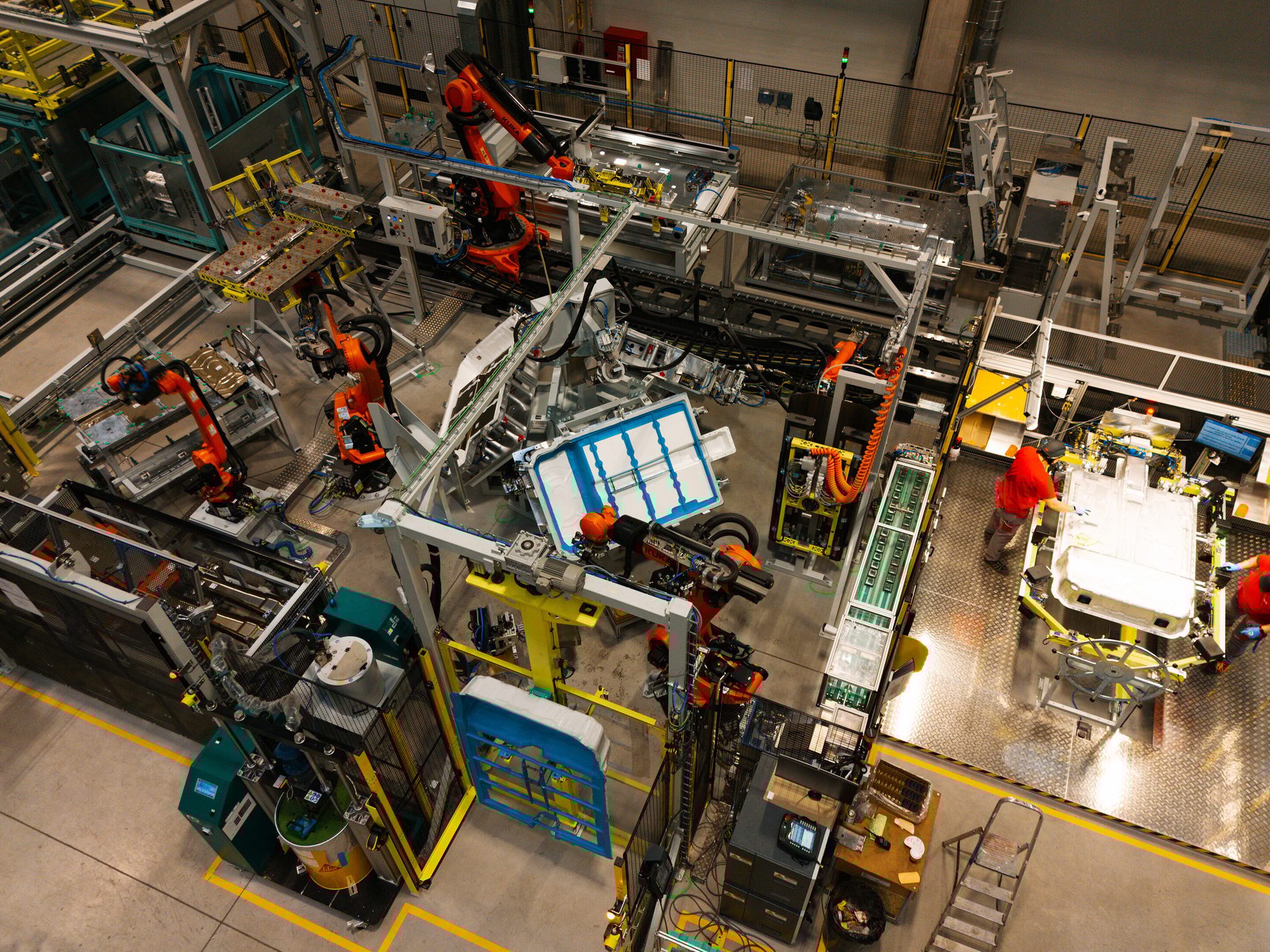
This automated line assembles EV battery enclosures made of aluminum, SMC and mica. Photo courtesy Robatech Group
Bonding the complex-shaped parts with a hot-melt polyurethane adhesive is a critical part of the assembly process. The precision and uniformity of the adhesive application directly affect the quality of the enclosure assembly.
“The adhesive dispensing technology on our existing assembly line did not meet our quality requirements,” explains Lukáš Mildorf, chief technology officer of Teijin Automotive. “Service availability was also unsatisfactory.”
When the company planned two additional assembly lines in 2022, it commissioned Czech machine builder JHV Solutions s.r.o. to develop and implement them. Based in Rosice, Czech Republic, JHV has been building automated assembly systems since 1999. The company has designed automated lines for a variety of automotive, medical and electronic assemblies.
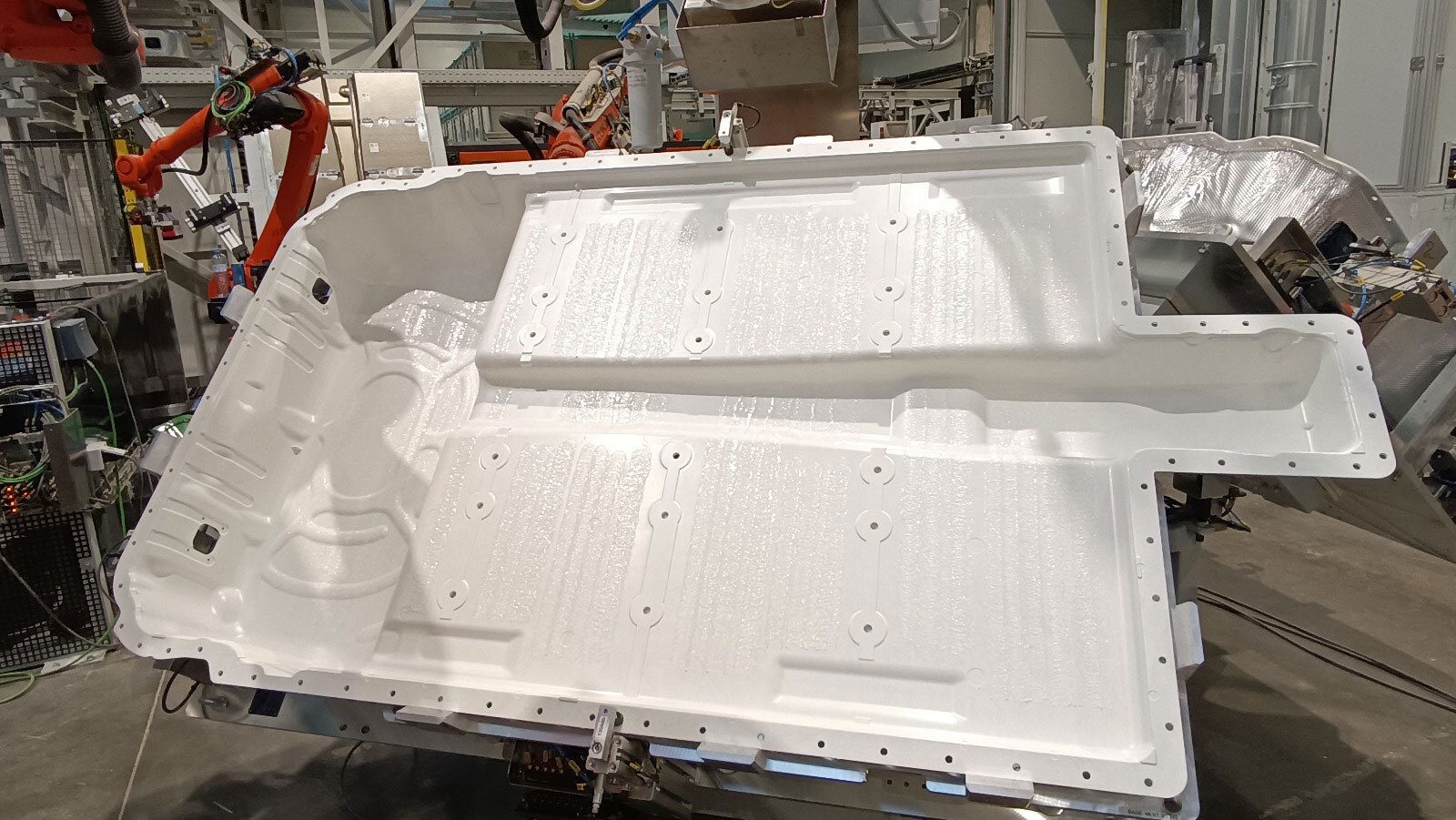
The precision and uniformity of the adhesive application directly affect the quality of the enclosure assembly. Photo courtesy Robatech Group
High-Quality Dispensing
The enclosure parts can be optimally bonded by spraying the hot-melt adhesive in a swirl pattern. Two factors are important. First, the swirls should be applied evenly in a row. This requires precise positioning and repeat accuracy. Second, the rows of swirls should be as close together as possible without overlapping. This requires precise edge accuracy of the swirl application. If both factors are met, there will be no unevenness on the surface of the parts, and the bond will be reliable.
Even the most skilled and experienced workers cannot manually spray the adhesive accurately enough. Six-axis robots were the only option. For that, JHV got help from another European company, the Robatech Group, and Kaletech, Robatech’s distributor in the Czech Republic.
Headquartered in Muri, Switzerland, Robatech has been manufacturing automated adhesive dispensing technology since 1975. Represented in more than 80 countries, the company makes dispensing equipment for any type of adhesive, including hot-melts.
Teijin tested the precision, stability and edge accuracy of the swirl application at Robatech’s headquarters in Muri in December 2022.
“We had the opportunity to produce prototypes of our parts before the production line was installed,” says Miloš Hrabák, production manager at Teijin Automotive. “This allowed us to adjust all the parameters for applying the adhesive to the materials so that production could then start smoothly. The support and service quality provided by Kaletech was excellent.”
Flexible Control
In August 2023 and January 2024, JHV installed the second and third production lines, each with identical workstations, in Milovice. At the first station, two six-robots from Kuka, equipped with Aero spray heads from Robatech, apply the hot-melt adhesive in a swirl pattern inside a deep-drawn aluminum sheet. An SMC laminate is then bonded to the aluminum. Previously, an application head with five spray elements was used for this application. Robatech uses six elements to reduce the time required for adhesive application.
Each spray element can be controlled individually. A single spray element is sufficient for applying adhesive to the edge of the sheet. For the flat part, elements are switched on or off as required during the movement of the robot. Although the adhesive is omitted in certain areas, the application quality remains stable throughout the dispensing process.
“The ability to control individual spray elements in real time has enabled us to achieve very high precision in adhesive application on complex, three-dimensional surfaces,” says Petr Jakube, project manager at JHV. “The previous supplier could not offer this flexibility.”
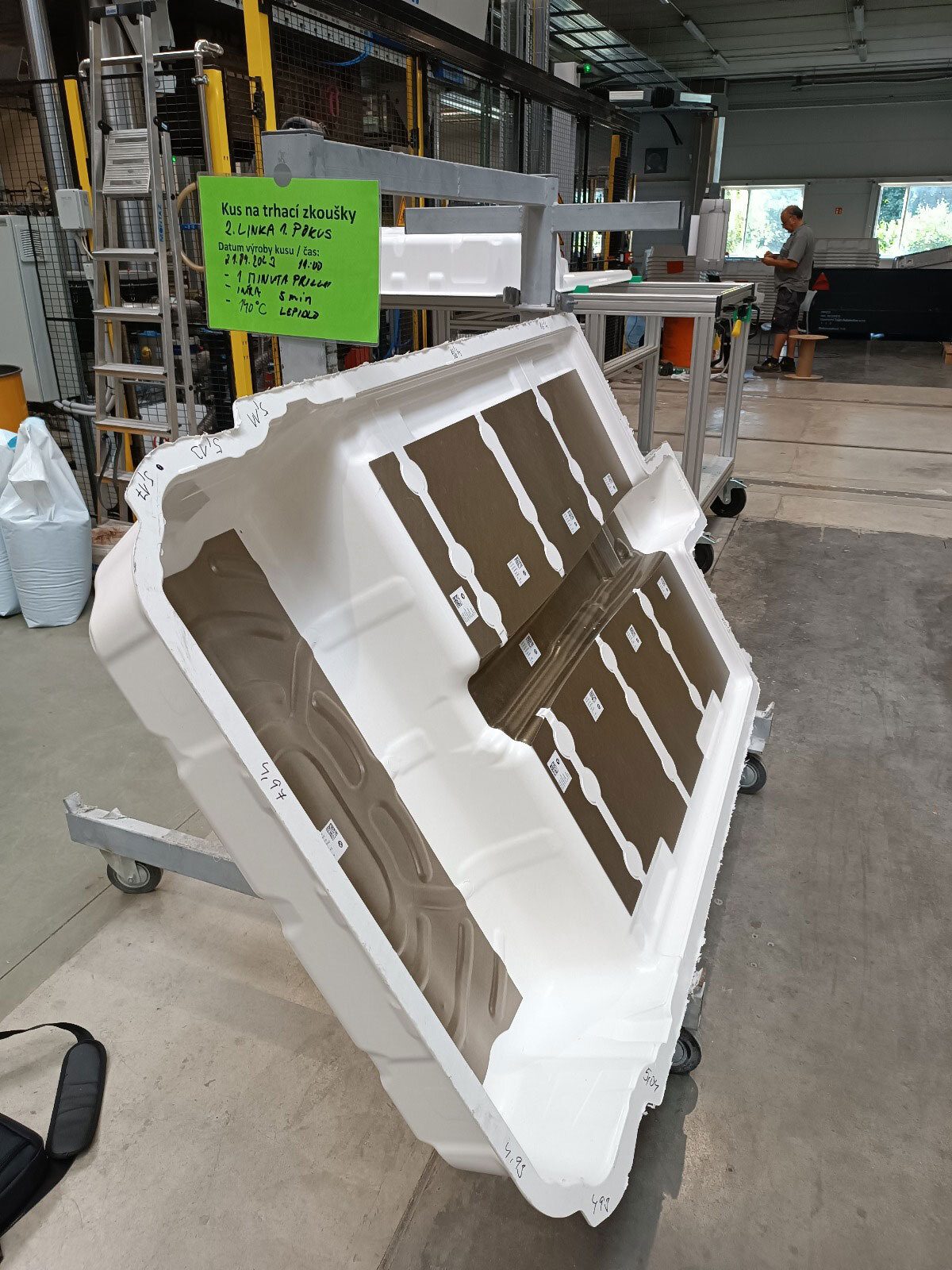
Mica plates are bonded to the enclosure assembly. Photo courtesy Robatech Group
At the second station, a mica plate is bonded to the assembly to increase burn-through safety. A Kuka robot and a Robatech spray head are also employed at this station. The flexibility of the robot and spray head are particularly important at this station, since mica plates in two different sizes are bonded. Each plate needs a different amount of adhesive.
“Normally, two application nozzles would be required. However, every nozzle change costs time,” explains Tomáš Langer, project manager at Kaletech. “The Aero application head offers the advantage that the adhesive application quantity can be varied via the air pressure. This means we can manage with just one type of application nozzle.”
For melting and conveying the hot-melt adhesive, Robatech uses one RobaDrum 200 melter and two MultiMelt melters per production line.
Switching to an adhesive application system from Robatech has brought numerous advantages to Teijin Automotive. These include:
• Guaranteed quality thanks to high edge accuracy and precision of the swirl application.
• Efficiency and flexibility thanks to variable adhesive application quantities and simplified spare parts management.
• Better reliability of the dispensing equipment.
• Reliable and fast service from Kaletech.
“By working with JHV and Kaletech, we have been able to significantly increase our quality and efficiency,” says Mildorf. “We are very satisfied with the technology, but also with the support and customer service. Both are of great value in our industry.”
For more information on dispensing equipment, click www.robatech.com. For more information on automated assembly systems, click www.jhv.cz.
ASSEMBLY ONLINE
For more information on adhesive dispensing systems, visit www.assemblymag.com to read these articles: