
AUTOMATION REVIEW

CONTACT
Austin

Lightweight battery-powered aircraft are ready for take-off.
Robots Assemble Automotive Sensors
John Sprovieri // Chief Editor
Erwin Quarder Systemtechnik designed and built a fully automated production system that begins with the molding of the parts and ends with finished sensors. Photo courtesy Denso Robotics
A typical vehicle contains 60 to 100 sensors. Specialty models, or higher-end cars with more safety and convenience features, can have more than 200 sensors.
Some sensors, like the oxygen sensor or the mass air flow sensor, keep the engine running efficiently. Others, like the air bag sensor or tire pressure sensor, are safety related. Still others, such as temperature or light sensors, are related to driver comfort or convenience.
Given their small size, high production volumes and exacting precision requirements, these sensors are not assembled manually. Automation is the only way to go.
An important and challenging part of the assembly process is attaching the sensor to a carrier. The carrier helps to integrate the sensor into various systems, whether it’s for physical mounting, environmental protection, or network connectivity.
The sensor is often attached to the carrier using a wave-soldering process. Ideally, the height of the solder wave should be consistent. However, molten solder, like any liquid, can be unpredictable. Slight variations in height are unavoidable, and that means the height of each carrier assembly as it passes over and through the wave must be adjusted on the fly.
This was the challenge faced by manufacturing conglomerate Erwin Quarder Systemtechnik GmbH & Co. in Espelkamp, Germany, about 60 miles west of Hanover.
Let Fusion help streamline your brazing or soldering process! We transform manual processes into turnkey automation systems, providing years of cost-efficient production. Cut labor costs, increase production, and optimize output. Contact us for a free consultation!
Fusion Incorporated
440-946-3300 / 800-626-9501
Automated Brazing and Soldering Machines
AUTOMATION ASSEMBLY PRODUCTS
Founded in 1971 by engineer Erwin Quarder, the company began as a manufacturer of tools for stamping and injection molding. Over time, the company began adding complementary services. As long as we’re making the mold, management reasoned, why not make the parts, as well? And, if we’re making the parts, why not assemble them? The company’s automation division grew out of the need to make equipment to do just that.
For the automotive sensor, Erwin Quarder Systemtechnik designed and built a fully automated production system that begins with the molding of the parts and ends with finished sensors. The assembly line incorporates multiple processes, including insertion of the sensor onto a carrier, fluxing and soldering, test and inspection, and finally placing the finished assemblies into trays.
Robot Adjusts on the Fly
Six-axis robots from Denso Robotics are the workhorses of the system. For example, a Denso VS 6556G robot plays a key role in the wave-soldering process. The robot is equipped to carry a custom soldering fixture that holds four sensor assemblies. In a precise motion, the robot must pass the fixture over and through the solder wave.
The AGV provides 50-course 128-command control, programming. The AGV is a model HA-A50060 single-direction AGV drive unit with 90° and 180° spin/turn capability. The unit can travel with speeds up to 164 fpm (50 M)/min and can carry a load capacity of up to 1320 lb.
Creform Corporation
800.839.8823
SCsales@creform.com
www.creform.com
AGV system with powered conveyor help increase productivity.
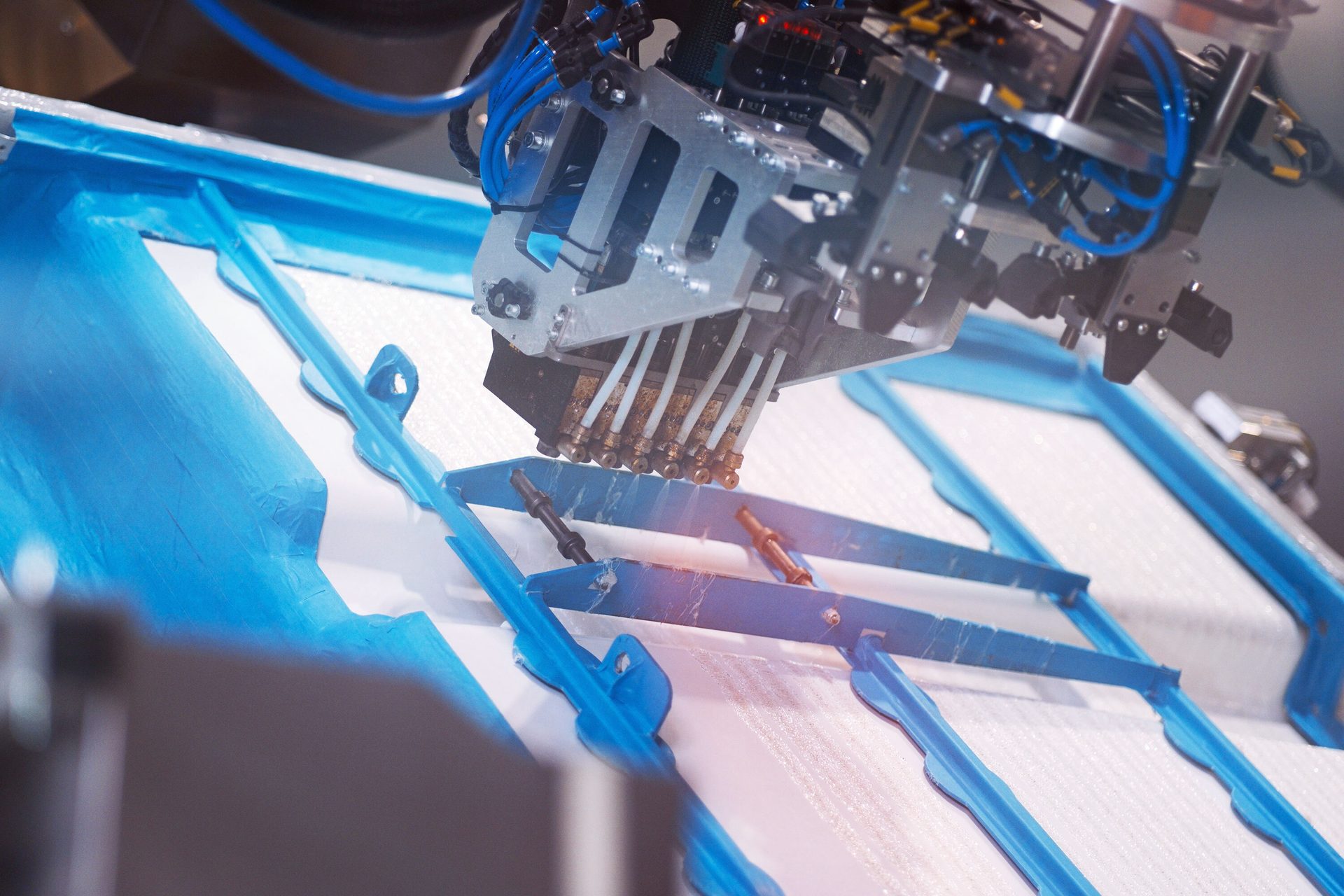
The robot is equipped to carry a custom soldering fixture that holds four sensor assemblies. Photo courtesy Denso Robotics
The task is more difficult than it sounds. Although the height of the solder wave is set at 4 millimeters, the actual height of the wave can deviate by as much as 1 millimeter. As a result, if the height of the fixture remains constant, some assemblies could get too little solder and some too much.
To prevent that from happening, a sensor continually monitors the height of the solder wave and reports that value to the robot controller. This enables the robot to adjust to the position of the fixture on the fly so it’s always at the ideal height for soldering.
item America delivers automation solutions that keep production moving efficiently. Our conveyor belt systems offer smooth, reliable transport for materials, seamlessly integrating into your processes to maximize productivity and minimize downtime in manufacturing environments.
item America LLC
+1 864 942 0105
Powerful Automation: item Conveyor Belts
ACE Controls delivers precision motion control solutions that enhance automation system performance. Our shock absorbers and gas springs ensure smoother, faster, and more reliable machine operation. Trusted across industries, our products help reduce downtime and increase productivity, making them an essential component in today’s high-performance automated assemblies.
ACE Controls
(248) 476-0213
ACE Controls Streamlines Automation Efficiency
The soldering process must be as precise as possible, to prevent damaging the sensors or deforming the carriers. Once the soldering process has been completed—it takes 30 to 32 seconds per fixture—the robot places the fixture back on the assembly line for quality control.
At the end of the line, a VS 060 robot picks and places the finished sensors into trays for shipping to an automotive OEM.
Boulware Equipment, LLC is 100% committed to repurposing industrial wood waste. We convert industrial wood trash into a valuable product and have a nationwide network of wood fiber buyers who rely on our systems supply of predictable quality.
We deliver our clients a reliable “Turn-Key” wood waste solution for almost any pallet / crate & industrial wood waste problem in manufacturing and assembly industries. We offer our systems nationwide.
Boulware Equipment, LLC
704-651-6061
Boulware Systems Keep Wood Trash Out of Landfills
The MPXS Series micro vacuum pumps from COVAL offer compact, high-speed performance with smart control. Weighing just 87g, they mount close to the part to reduce air use and cycle time. With ASC energy savings, IO-Link connectivity, bankability, and modular options, MPXS is ideal for robotics, electronics, and pharmaceutical automation.
COVAL Vacuum Technology, Inc.
919-233-4855
MPXS Series Micro Vacuum Pumps
The robots are fully integrated into the system via a Profibus network. All figures for the soldering process are being transmitted as integer variables, including soldering angle, soldering height, duration, speed and time. The robots were programmed in WinCaps using PacScript.
Linked by an external VPN connection, the Ethernet-based control can be accessed by engineers on a touch screen control panel. Here, engineers can individually adjust all parameters of the soldering process, such as speed, path, duration and angle. This is a big advantage when assembly of different sensor models is required. It enables engineers to quickly and easily modify the soldering process without having to go through the time and effort of re-programming the base settings.
Quarder has been using Denso robots since 2013. The company chose the VS 6556G due to its six axes of motion, since the soldering process requires mobility and flexibility. The robot’s 7-kilogram payload capacity was important, since a fully loaded fixture weighs approximately 2 kilograms. The robot’s 0.49-second cycle time and its repeatability of ±0.02 millimeter were crucial, as well.
Working in a three-shift operation, the system assembles 10,800 sensors every 24 hours. The error rate of the soldering process is just 1 percent.
For more information on robots, visit www.densorobotics.com. For more information on assembly automation, visit www.quarder.de.
RACO International provides customized, precise products that enhance efficiency and reliability in industrial operations. Our global expertise and commitment to quality offer innovative solutions tailored to business needs, boosting productivity and competitiveness in the industrial sector.
RACO International, L.P.
412-835-5744
We are Linear Motion People
“A company with Ford’s scale can really influence the supply chain and business practices across our entire industry,” adds Sue Slaughter, purchasing director at Ford Motor Co. “It is so important that we not only think about how [we] can use our purchasing power to fuel our business needs, but also to advance sustainability.”
Because the automotive supply chain is extremely complex, the Guiding Principles contain expectations about business ethics, working conditions, human rights, health and safety, environmental leadership and supply chain due diligence for suppliers at all tiers. All suppliers are expected to uphold these standards and enforce them throughout their supply chain.
The Guiding Principles are based on fundamental elements of social, environmental and governance responsibility that are consistent with applicable laws and international standards created by organizations such as the United Nations.
Topics covered under the revised guidelines include the following:
Business ethics, including counterfeit parts and data protection.
Environmental issues, such as air quality, carbon neutrality, chemical management, circularity and water management.
Health and safety issues, such as personal protective equipment and workspace.
Human rights and working conditions, such as benefits, wages and working hours.
Responsible supply chain management, such as ethical sourcing of raw materials.
The BMW Group has implemented several projects in its packaging logistics unit to help the environment and conserve resources. The goal of the initiative is to work closely with suppliers to reduce carbon emissions and adhere to the principles of a circular economy.
BMW’s European assembly plants are using more recycled material in their packaging. For newly awarded contracts, the proportion of recycled material in reusable packaging for logistics purposes will almost double this year from around 20 percent to over 35 percent.
Using alternative sustainable materials, reducing single-use packaging, introducing lightweight packaging in certain areas and reducing transport volumes will also help cut carbon emissions.
BMW is monitoring the impact of individual measures via a CO2 calculator for packaging. The automaker’s overall aim is to reduce CO2 emissions in the supply chain by 20 percent per vehicle compared to 2019.
“Our re:think, re:duce, re:use, re:cycle approach is being implemented consistently in packaging logistics,” says Michael Nikolaides, head of production network and logistics at BMW Group. “We’re using innovative strategies to consistently reduce the volume of resources we use, thus reducing our carbon footprint.
“We are also doing our part to get the BMW iFACTORY up and running, with a particular focus on the ‘green’ side of things…with an emphasis on flexibility and efficiency, sustainability and digitalization,” explains Nikolaides. “It provides an answer to the challenges involved in the transformation to e-mobility and [leverages] the latest technologies to create a production process that uses minimal resources.”
According to Nikolaides, BMW is using more recycled material, such as expanded polypropylene (EPP) packaging. “Our newly developed EPP packaging already contains 25 percent recycled material,” he points out. “EPP is used in special containers, as its shape can be adapted to the components being packaged, allowing them to be transported safely.
“Around 360,000 of these containers are needed each year,” claims Nikolaides. “Using 25 percent recycled material allows us to save almost 280 tons of CO2 annually. There are plans to increase this proportion of recycled material even further, with the first pilot schemes with 100 percent recycled material currently underway. If these tests are successful, this configuration will become standard for new contracts from 2024.
“An additional 680 tons of carbon emissions savings can be made every year by using covers and so-called small load carriers with 50 percent recycled contents,” says Nikolaides. “As things stand, these measures are focused within the European markets due to the current waste management situation and available recycling infrastructure. But, we are working toward expanding to our locations in China, Mexico and the United States.”
BMW also plans to use folding large load carriers in place of traditional pallet cages made of steel. The plastic alternatives will be made from over 90 percent recycled material. They work in a similar way to the collapsible shopping crates that most people are familiar with.
When they’re empty, the carriers can be folded up, making them easier to transport. Nikolaides claims that using 15,000 of these new containers will reduce CO2 by around 3,000 tons per year.
“When it comes to packaging, the sky’s the limit,” says Nikolaides. “We’re launching pilot projects using bio-based materials to replace oil-based substances such as polyethylene and polypropylene.
“We are also investigating whether and in what ways we can use materials from recycled household appliances in our packaging,” explains Nikolaides. “In the long term, our aim is to use alternatives to raw materials across the board.”
BMW Initiative Targets Sustainable Packaging
BMW is using sustainable packaging in its assembly plants. Photo courtesy BMW Group
ASSEMBLY ONLINE
For more information on assembly robots, visit www.assemblymag.com to read these articles: