MONTH 2023

FROM THE EDITOR

In July, Deere & Co. released a new digital service tool to enable equipment owners in the U.S. and Canada to maintain, diagnose, repair and protect their farm machinery.
That may not sound like big news, but the release is a direct response to anti-competition claims raised in an ongoing right-to-repair lawsuit filed by the Federal Trade Commission (FTC) against Deere in January. The FTC accuses Deere of presiding over a monopolistic and anti-competitive repair and dealer service system that puts farmers and independent repair professionals at an unfair disadvantage.
Fixing machines was much simpler before computers and electronics were embedded in just about everything. When something broke, you took it to an expert and explained the problem. The expert would know exactly what the issue was, then he would remove the broken part and install a new one.
Today, you plug the machine into a diagnostic computer, and it tells a technician what the problem is. That is the crux of the FTC’s lawsuit. The commission claims that Deere does not allow independent technicians to access the computers onboard its tractors. That ability is reserved solely for Deere dealerships. The FTC—and most farmers—think that’s unfair.
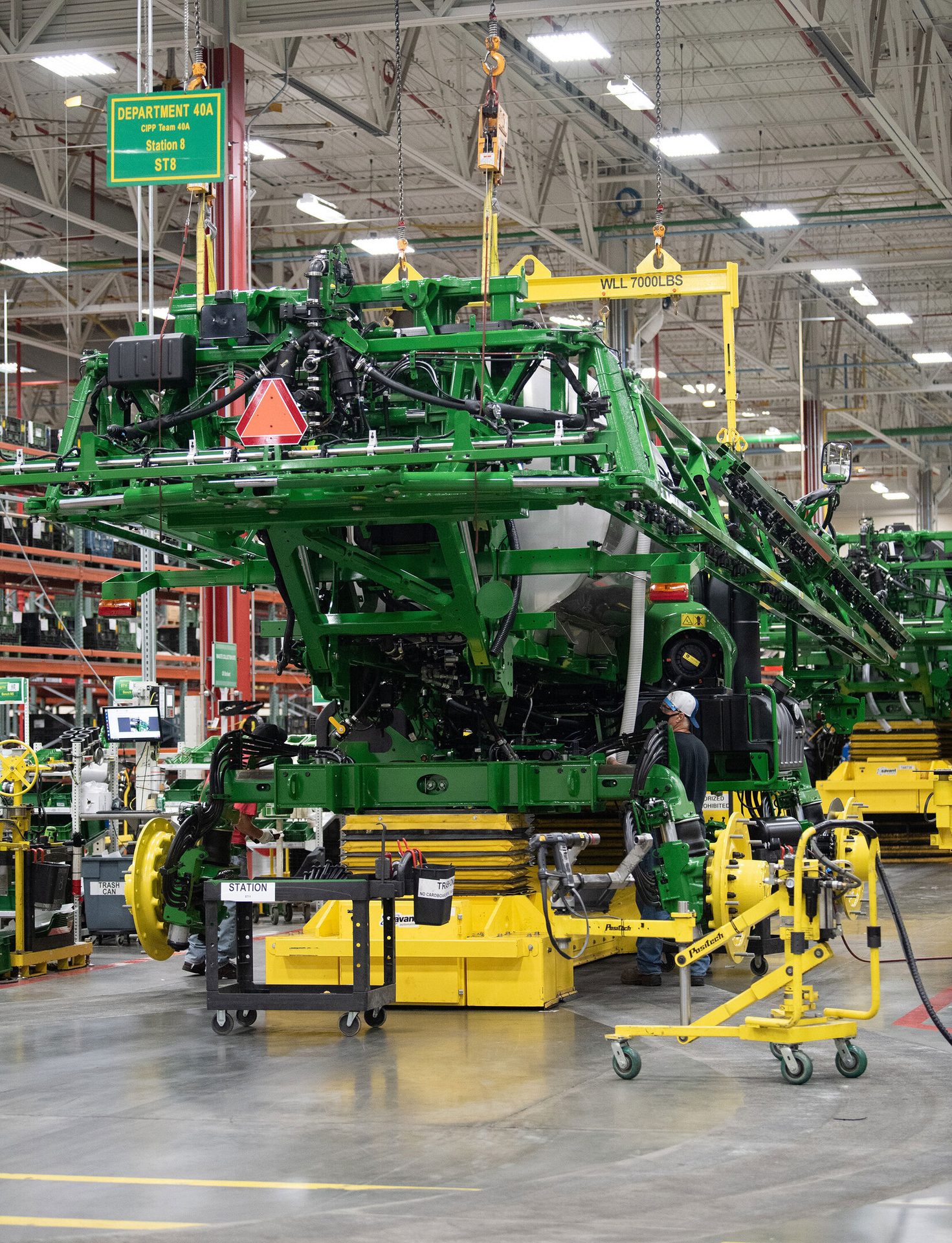
The OBBBA provides U.S. manufacturers with a host of tax incentives for investing in domestic production facilities. Photo courtesy Deere & Co.
Deere is not alone in that strategy. Many OEMs don’t want consumers to fix their devices themselves or take them to local repair shops. Instead, OEMs would rather have consumers purchase a new device or pay them to fix it, often at a cost that’s much more than what an independent shop would charge. Many OEMs don’t sell genuine replacement parts to consumers, nor do they provide repair documentation. And, some OEMs assemble their products with proprietary screws that cannot be unfastened with standard tools. (In their defense, OEMs argue that third-party repairs could be unsafe for consumers and technicians.)
Frustration behind such tactics is the impetus behind the “right-to-repair” movement, which advocates that consumers have a right to fix machinery, appliances, electronics and other products.
Lawmakers in every state in the union have filed legislation to ensure that consumers have access to the parts, tools, and documentation needed to repair their stuff. (Wisconsin was the last domino. A right-to-repair bill was introduced there in February.) This year alone, right-to-repair legislation is being actively debated in 24 states. Five states—New York, California, Minnesota, Oregon and Colorado—have already passed right-to-repair legislation for electronics.
Farmers aren’t the only people frustrated by the inability to repair their own equipment. So, too, is the U.S. military. In an April 30 memo, Defense Secretary Pete Hegseth directed the Army secretary to “identify and propose contract modifications for right-to-repair provisions where intellectual property constraints limit the Army’s ability to conduct maintenance and access the appropriate maintenance tools, software and technical data.”
What’s more, both the U.S. House and Senate have included right-to-repair provisions in their versions of the 2026 defense appropriation bills, and the idea has bipartisan support.
The military supports the provisions, arguing that they can’t afford any delays in serving equipment. “I’ve lived what it means when a piece of equipment fails at a critical time,” says Lt. Col. Cindy Serrano Roberts in a July article in the Military Times. “I know how far away contractors can be when you need them most, and I know what our service members are capable of—if we trust them with the tools and training to do the job.
“Right now, private companies can put restrictions on military equipment that block troops from making even basic repairs,” she continues. “That slows everything down, costs taxpayers more, and in the worst cases, puts lives at risk.”
OEMs are opposed to the provisions. In July, the Associated Equipment Distributors (AED), a trade group whose members distribute and service construction, material handling and other industrial equipment, characterized the provisions as a threat to equipment dealers. The AED argues that enabling the military to fix its own equipment is a slippery slope to granting everyone that same ability.
Like it or not, manufacturing and design engineers will need to keep an eye on such proposals and adjust their designs accordingly.

The risk of China decoupling is an important consideration for companies sourcing there.
About the Author
Harry Moser is the president of the Reshoring Initiative. His column will appear every other month, alternating with Austin Weber’s “On Campus.” Has your company reshored production? Are you thinking about it? We’d like to hear of your success or help you achieve it. With your approval, we would love to report on your successes or opportunities in future issues. Contact harry.moser@reshorenow.org.