Susan
Hines
Gypsum Recycling: Opportunities and Challenges in a Circular Economy
While recycling gypsum drywall can significantly reduce landfill waste practical barriers make large-scale circular recycling complex, requiring coordinated efforts across manufacturers, contractors, recyclers, and policymakers to develop sustainable, localized solutions.
Brooke Fishel
ALL THINGS GYPSUM
Gypsum panels, commonly known as drywall, are one of the most widely used building products in North America. They line nearly every wall and ceiling in homes, offices, schools, and commercial buildings. But as durable and ubiquitous as they are, gypsum panels invariably enter the waste stream either as clean cutoffs from new construction or as demolition or deconstruction debris following years of in-place, reliable service. How we manage this waste is becoming a pressing environmental and economic challenge.
A recent three-phase, three-year study conducted by the Gypsum Association, California Gypsum Material Flows for Life Cycle Impact Analysis and Recycling Assessment, sheds new light on the complexities of gypsum recycling. Combined with industry analysis in Gypsum Panel Recycling: Possible but Complex, the findings highlight both the promise and the challenges of creating a circular economy for gypsum.
Why Gypsum Recycling Matters
The construction industry generates massive volumes of waste, and gypsum panels are estimated to represent roughly 2.5 percent of the total weight according to the latest EPA data. Therefore, and not surprisingly, gypsum panel scrap from new construction and demolition makes up a portion of landfill material. While gypsum is not inherently hazardous, disposal can cause issues in landfills.
First, it takes up precious space. Second, gypsum’s chemical composition can lead to the production of hydrogen sulfide gas during natural bacterial decomposition in a landfill setting. Hydrogen sulfide gas is colorless, heavy and smells like rotten eggs.
At the same time, gypsum is a valuable resource. Both natural gypsum (mined) and synthetic gypsum (a byproduct of flue gas desulfurization in coal-burning power plants) share the same chemical properties, making them suitable for gypsum panel manufacturing. Recycling clean scrap into new panels reduces demand for virgin resources, conserves landfill space, and lowers greenhouse gas emissions associated with extraction and transportation.
The environmental logic is clear. But as the GA’s research demonstrates, the practical path forward is anything but simple.
The Broader C&D Waste Context: EPA’s Findings
According to the Environmental Protection Agency’s Advancing Sustainable Materials Management: 2018 Fact Sheet, the nation generated about 600 million tons of construction and demolition debris in 2018, more than twice the volume of municipal solid waste.
As shown in the EPA image below, drywall and plasters make up 2.5 percent of that debris generation.
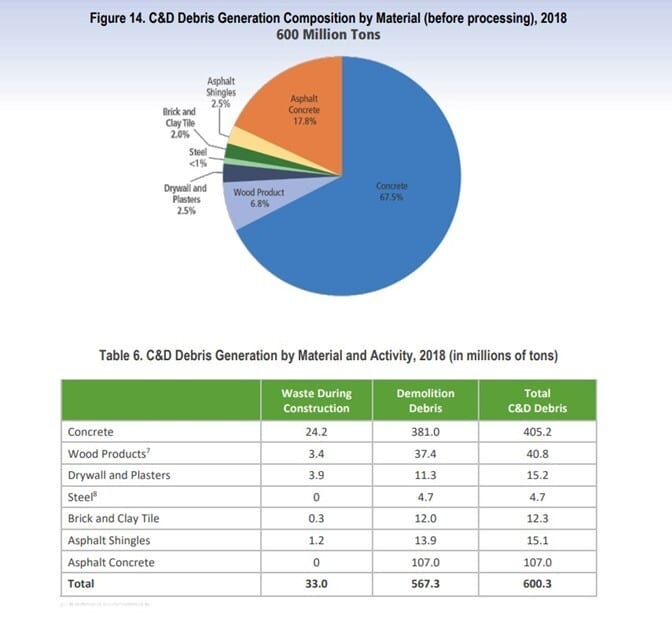
Roughly 455 million tons were reused or recycled, while 145 million tons were landfilled.
Demolition accounts for more than 90 percent of this debris, underscoring the challenge of recovering clean material for recycling.
Even diverting a small fraction of this massive waste stream could significantly reduce landfill use and resource extraction.
Closed-Loop vs. Open-Loop Recycling vs. Disposal
The GA study explored different recycling pathways for gypsum:
- Closed-loop recycling: Returning processed panel scrap directly into the production of new panels.
- Open-loop recycling: Repurposing processed gypsum for alternative, secondary market uses, such as soil amendments, composting additives, or as an ingredient in portland cement.
- Disposal: Landfilling waste when recycling is not practical or economical.
Closed-loop recycling is the “gold standard,” ensuring gypsum waste is reused in the same high-value application. But it requires stringent quality control by the gypsum recycler to maintain its code-compliant fire-resistive properties. Contamination from nails, paint, adhesives, or mixed debris makes demolition waste unsuitable for direct reuse in panel production. Clean scrap from manufacturing offcuts or construction sites is much easier to recycle into new gypsum panels, but demolition material remains a stumbling block.
Open-loop applications offer flexibility and provide an outlet for lower-quality scrap. Farmers have long used gypsum to improve soil structure, while cement producers use it to regulate cement setting times. However, open-loop markets fluctuate and often cannot absorb the full volume of scrap generated.
The challenge, then, is striking the right balance of maximizing closed-loop recycling of clean scrap where feasible, while expanding sustainable open-loop applications for the remainder, and knowing when the landfill is the most feasible option.
California as a Test Case
California provides a unique backdrop for gypsum recycling research. With a large construction industry, ambitious climate policies, and potential legislation to mandate recycling, the state is at the forefront of seeking viable, sustainable practices.
The GA’s three-year material flow study traced the life cycle of gypsum panels in California, from manufacturing and distribution to use, disposal, and recycling. Among its key findings:
- Transportation matters: Hauling scrap to centralized recycling facilities can sometimes offset environmental gains due to fuel consumption and emissions. Since regions and markets vary in size, developing localized recycling strategies is essential. Currently, no wallboard grade processing facilities exist in California.
- Market demand is uneven: While agriculture, cement and other applications exist, markets are regional and can be unpredictable.
- Policy plays a role: Establishing mandates or programs without data-driven, market-specific research can result in recycling becoming more costly or environmentally detrimental than landfilling in specific scenarios.
California’s situation underscores the need for tailored solutions. What works in one region, for instance, recycling into cement near a major producer, may not translate to another.
Industry Commitment and Next Steps
The gypsum industry recognizes both the responsibility and the opportunity in recycling. The GA and its member companies emphasize environmental stewardship and are investing in research, pilot programs, and stakeholder engagement to push solutions forward.
Updated resources on the GA’s recycling webpage [https://gypsum.org/recycling-gypsum-wallboard] now provide a central hub for best practices, technology developments, and policy discussions. Importantly, the industry is not treating California’s study as an isolated case. Rather, it represents a foundation for continued research by many stakeholders into national and regional strategies for advancing recycling where economically and environmentally viable.
Gypsum recycling stakeholders span the full lifecycle that includes production, construction, demolition, collection, processing and reuse.
Future progress will depend on collaboration:
- Manufacturers can support gypsum panel recycling by producing products that incorporate higher percentages of recycled gypsum, being mindful not to compromise essential product performance requirements, and by partnering with qualified recyclers to ensure consistent quality standards.
- Construction and Demolition Contractors can play a role by separating gypsum panel waste on job sites to keep it cleaner and more recyclable, which is crucial because they control the waste at its source.
- Recyclers/Processors can improve gypsum panel recycling by keeping material streams clean, investing in better separation technologies, and supplying consistent, high-quality recycled gypsum to manufacturers and other end users.
- End Market Users such as cement producers, farmers, and industrial users can strengthen gypsum panel recycling by creating steady demand for high-quality recycled gypsum by adopting recycled material into their products and practices.
Toward a Circular Gypsum Economy
The story of gypsum recycling is not one of simple solutions, but of incremental progress and ongoing innovation. Recycling is possible, but the path is complex, shaped by market conditions, transportation logistics, material quality, and regulatory frameworks.
What’s clear from both the GA study and industry analysis is that gypsum has the potential to play a central role in the construction industry’s shift toward a more circular economy. Instead of being buried in landfills, scrap gypsum panels can become feedstock for new products, closing the loop on one of the sector’s most common materials.
California’s experience may serve as a model, or at least a cautionary tale, for other states and regions. By grappling with the practical realities of recycling, the gypsum industry is laying the groundwork for more sustainable construction practices nationwide.
The future of gypsum recycling will depend on how well all the stakeholders align their efforts. With collaboration and commitment, the walls we build today could become the walls we recycle tomorrow.
Opening Background Image Credit: Franck-Boston/iStock / Getty Images Plus via Getty Images.
Chart and Table Credit: Gypsum Association
Brooke Fishel is director of Stewardship and External Affairs at the Gypsum Association. She can be reached at bfishel@gypsum.org.